A nebuliser is a small machine that turns liquid medicine into a fine mist, which you breathe in through a mask or mouthpiece. You breathe normally while it runs, so it gets medicine into your lungs without the timing and technique an inhaler needs. Most people who use a nebuliser at home have a long-term lung condition and were set up with it by a respiratory team.
You'll also see it spelled nebulizer, which is the American spelling. It's the same device.
What does a nebuliser do?
Its job is delivery. A nebuliser doesn't do anything for your lungs by itself. Any effect comes from the medicine your doctor, nurse or pharmacist has prescribed. What the machine changes is how that medicine reaches you. Instead of a single puff you have to breathe in at exactly the right moment, you get a steady mist over several minutes and take it in with ordinary breaths.
That matters for anyone who finds an inhaler hard work. It might be someone too breathless to take a deep, slow breath, or someone whose arthritis makes pressing a canister difficult. Some medicines, such as dornase alfa for cystic fibrosis, only come in a form you nebulise.
How does a nebuliser work?
Every nebuliser has the same few parts:
- the machine, which provides the power to make the mist
- a medicine cup, sometimes called the chamber or pot, which holds the liquid
- tubing, on compressor models, linking the machine to the cup
- a mask or mouthpiece that you breathe through
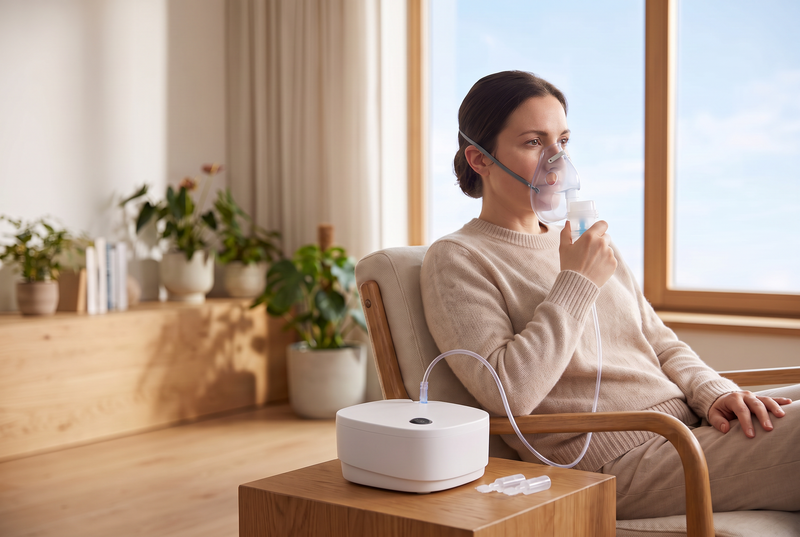
The type most people use at home is the compressor nebuliser, also called a jet nebuliser. A small pump inside the machine pushes air down the tubing and through a tiny hole at the bottom of the medicine cup. That fast stream of air draws the liquid up and breaks it into droplets. The bigger droplets hit a small plastic part called a baffle and drip back into the cup, so what comes out of the top is a fine mist. NHS leaflets point out that if the baffle isn't in place, the nebuliser won't work.
Two other types get to the same place differently. Mesh nebulisers push the liquid through a vibrating plate full of microscopic holes, which makes them small and almost silent. Ultrasonic nebulisers use high-frequency vibration. Not every medicine suits every type. The patient leaflet for Pulmicort Respules, a nebulised steroid, says not to use an ultrasonic nebuliser with it, for example. You can see how compressor nebulisers compare with mesh nebulisers in our side-by-side table.
What is a nebuliser used for?
Asthma + Lung UK is clear that you should only use a nebuliser at home if your healthcare professional has prescribed it. The people who are given one usually have:
- cystic fibrosis
- bronchiectasis
- COPD, where a hospital team or consultant has arranged it
- pulmonary fibrosis
- severe asthma, under specialist care, especially if they can't use an inhaler well
Nebulisers turn up elsewhere too. Hospitals use them for people who are too unwell to manage an inhaler. Some people are given saline to nebulise after treatment for head and neck cancer, to keep secretions loose, and some children with neurodisability use saline for the same reason.
All of these have one thing in common. A clinician decided a nebuliser was the right way to give that person their medicine. It isn't a general remedy for coughs and colds, and it isn't something to start on your own.
What goes in a nebuliser?
The liquid in the cup is the medicine, and it should always be something a doctor, nurse or pharmacist has prescribed or recommended. The main groups are relievers such as salbutamol and ipratropium, which open the airways, and steroids such as budesonide, which calm inflammation. Then there's saline, which is sterile salt water used to moisten the airways or loosen mucus. Some people with cystic fibrosis or bronchiectasis nebulise antibiotics, and mucolytics such as dornase alfa thin sticky mucus. Many of these come as nebules, small plastic vials that each hold one dose.
Kestlo doesn't supply any of these. And some things should never go in a nebuliser at all: tap water, plain water, essential oils, cough syrup and vapour rubs. PARI, one of the biggest nebuliser makers, says cough syrups and rubs are totally unsuited to nebulising, and that essential oils can set off breathing problems in people with sensitive airways. Tap water can carry germs, and a nebuliser sends whatever is in the cup deep into your chest.
What happens during a session?
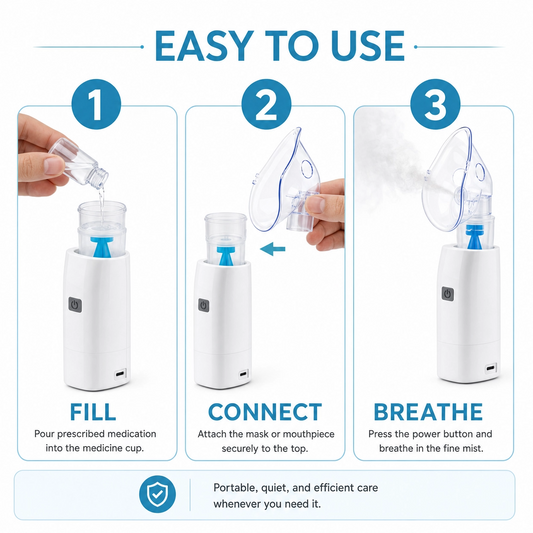
It's simpler than most people expect. You sit upright, put the medicine in the cup, fit the mask or mouthpiece and switch on. Then you breathe normally, through your mouth if you're using a mouthpiece, until the mist stops. Tapping the side of the cup towards the end knocks droplets back down so less is wasted.
How long it takes depends on the medicine and how much is in the cup. NHS leaflets give anything from 5 to 10 minutes to 10 to 15 minutes. How often you use it is your prescriber's call, not something to work out yourself.
Afterwards, rinse your mouth and wipe your face, especially after a steroid. Wash the cup and mask or mouthpiece the way your instructions say and leave them to air dry. Compressor machines also need a break between sessions. Kestlo's run for up to 30 minutes and then need 30 minutes off, which is longer than most sessions last.