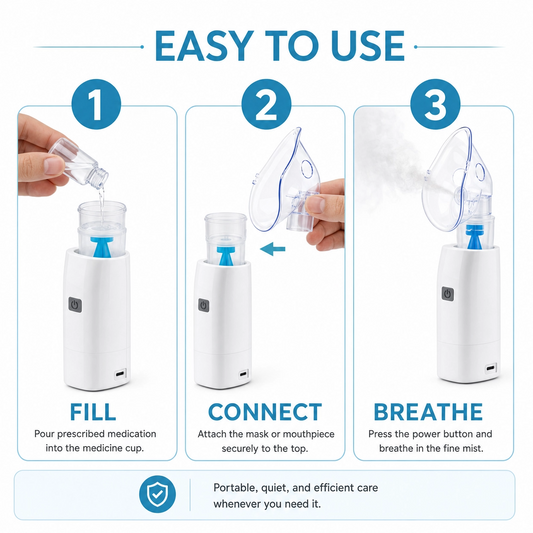
Saline for nebulisation is sterile salt water, made specifically to be breathed in as a mist through a nebuliser. It comes in two main kinds. Normal saline, at 0.9%, is used to moisten the airways or to dilute other nebulised medicines. Hypertonic saline, usually 3%, 6% or 7%, is stronger and helps loosen thick mucus so it's easier to cough up. Both are used on the advice of a doctor, nurse, physiotherapist or pharmacist, and neither is something to make at home.
This guide explains the difference between the two, why people are asked to nebulise with saline, how a session runs and how to do it safely. If you're new to nebulisers altogether, start with what a nebuliser is and what it does.
What is nebuliser saline?
Nebuliser saline is a sodium chloride solution, salt dissolved in purified water, made sterile and sealed in single-dose plastic vials called nebules. That's why you'll see it listed as sodium chloride nebuliser solution on prescriptions and pharmacy shelves. American sites call it saline solution for a nebulizer, which is the same thing. A saline nebule is twisted open, squeezed into the medicine cup and used once.
Normal saline for nebulisation gets its name because 0.9% is roughly the same salt concentration as your body's own fluids. Hypertonic simply means saltier than that. The difference in strength matters a great deal, which is why the two are treated so differently.
Normal saline and hypertonic saline
| Strength | Also called | Examples you may see in the UK | How it's typically used |
|---|---|---|---|
| 0.9% | Normal or isotonic saline | Saline Steri-Neb, Saline Steripoules (2.5mL) | Diluting other nebulised medicines, and moistening the airways or loosening secretions on a clinician's advice |
| 3% | Hypertonic saline | MucoClear 3% | Mainly children with cystic fibrosis, and some people with secretions that are hard to clear, started by a specialist team |
| 6% | Hypertonic saline | MucoClear 6% | Adults with cystic fibrosis or bronchiectasis, started by a specialist team |
| 7% | Hypertonic saline | Nebusal 7%, Resp-Ease 7% | Adults with cystic fibrosis or bronchiectasis, started by a specialist team |
NHS formularies list hypertonic saline as a medical device for use on specialist advice, and the shared care guideline for Nebusal 7% says it isn't suitable for children under six. Which strength you use, how much and how often is for your team to decide. Don't swap one strength for another.
Why is saline nebulised?
Normal saline mainly adds moisture. Hypertonic saline goes further, drawing water into the lining of the airways so mucus becomes thinner. Asthma + Lung UK explains that saltwater solutions help loosen phlegm and make it easier to cough up, and lists bronchiectasis, cystic fibrosis and pulmonary fibrosis among the conditions where it may be used.
In practice, UK teams ask people to nebulise with saline for a handful of reasons:
- to dilute another nebulised medicine, which is what normal saline nebules are licensed for
- before airway clearance in bronchiectasis, where British Thoracic Society guidance says normal or hypertonic saline should be considered if mucus is thick and sticky
- as part of a daily routine in cystic fibrosis, alongside physiotherapy
- to keep secretions loose after treatment for head and neck cancer, or for children with neurodisability who find it hard to clear their chest
- for some people with complex COPD or asthma, but only through their respiratory team
What links all of these is that a clinician has looked at the person and decided saline will help them clear their chest. It's a treatment that's started for a reason, not a general way to freshen up your lungs.
What the evidence says
The strongest evidence is in cystic fibrosis. A Cochrane review found hypertonic saline seems to work well as an add-on to physiotherapy. In the largest trial it looked at, 41% of people using hypertonic saline went 48 weeks without a flare-up, compared with 16% in the comparison group. The same review was less sure about effects on lung function, and it says the picture needs looking at again now that many people with cystic fibrosis take newer medicines.
In bronchiectasis, the BTS says both normal and hypertonic saline can improve quality of life related to cough, though the number of studies is small.
Babies are a different story. NICE guidance on bronchiolitis says hypertonic saline should not be used to treat babies or children with bronchiolitis, and a large UK trial found it added no benefit to standard care. Some international reviews have found a small effect on hospital stays, but UK guidance is clear. Don't nebulise saline for a baby with bronchiolitis unless a clinician has told you to.
We couldn't find UK guidance that supports nebulising saline for colds, blocked sinuses, croup or an ordinary cough. For any of those, speak to a pharmacist or GP.